
This article contains Amazon affiliate links. If you buy through them, I earn a small commission, at no cost to you.
Quick Summary:
- After 3 months away from the gym, my scale weight rose only about 1 kg (2.2 lb), but my waist grew to 96.3 cm (37.9 in): the tape found what the scale hid.
- My body scan still shows 43.7 kg (96 lb) of skeletal muscle and a metabolic age of 35 at a passport age of 47, because muscle built over years does not vanish in 12 weeks.
- Getting back in shape after 40 starts with an honest baseline: I am publishing all 20 of my starting numbers here and following a 12-week plan with monthly public check-ins.

- The 3 months that took me out of the gym
- What I expected the damage to be
- What the scan actually said
- What the tape measure found (the honest metric)
- Why you lose less muscle than you think after 40
- My 12-week plan for getting back in shape after 40
- The scoreboard I am actually using this time
- Frequently asked questions
- Final thoughts
- References
New: the FitnessForties Training App. 10 programs for men over 40, deload weeks built in, works with no signal. USD 10, once. See the app
This is the post I did not want to write. For 11 weeks this blog went silent, and so did my training. Getting back in shape after 40 is the topic I have written about for other men since this site started. This time I am the case study, with all my real numbers published below, including the ones I am not proud of.
This morning I stepped on my body composition scale, took out an electronic tape measure, and recorded 20 baseline measurements. Some of them surprised me in a good way. One of them did not. This post is the honest audit of what 3 months away from the gym actually cost me at 47, what it did not cost me, and the exact 12-week plan I am following to come back. I will publish my check-in numbers every month, so you can watch this work or watch me fail in public.
The 3 months that took me out of the gym
From May to August I trained maybe once a week, badly. My diet drifted to whatever was available in train stations and airports. My sleep was inconsistent on the good nights and terrible on the rest. The reason was life, not laziness: a serious health situation hit my family this spring, and I spent these months shuttling between Zurich and Italy to be present, while carrying the most intense stretch of work pressure I have had in years.
I am not sharing that for sympathy. I am sharing it because this is exactly the profile of the man this blog is written for. Nobody reading this is 22 with nothing on the calendar. After 40, training interruptions do not come from lack of motivation, they come from parents, kids, careers, and crises that do not ask for permission. The question is never whether life will knock you out of your routine. It will. The question is what actually happens to your body when it does, and how you restart without wrecking yourself.
And I have been here before. At 44 I lost several months to chest rib surgery, came back with a coach, and rebuilt to my best shape in years. That comeback taught me that the restart is a skill in itself. This post is me applying that skill with better data, and this time in public. If stress was part of your own detour, my guide on cortisol and stress management after 40 covers what that pressure does under the hood.
What I expected the damage to be
In my head, the damage was catastrophic. Here is the embarrassing part: on May 23, the last thing I published before going silent was a post about why your body image scoreboard needs an upgrade. I wrote, with conviction, that the scale is the dumbest single metric a man over 40 can anchor his self-worth to. Then life hit, and my brain went straight back to the oldest anchor I own.
Here is why. At 42 I started a coached transformation at 85 kg (187 lb) and got down to about 70 kg (154 lb) at my leanest, working toward a photoshoot. Those 2 numbers burned themselves into my identity: 85 means bad, 70 means good. So when I felt my shape slipping this summer, my brain ran the old math: you are heavy, you are basically back where you started at 42, and now you are 47. Worst shape in 3 years, case closed. I genuinely believed the data would confirm a disaster.
That anchor is not just outdated. It is mathematically impossible without self-sabotage. My scan shows 65.5 kg (144 lb) of lean mass today. To weigh 70 kg (154 lb) again I would need to be at roughly 6% body fat, stage-shredded, or I would have to burn off kilos of the muscle I spent 5 years building. The 70 kg version of me was a different body arriving from a different direction. Chasing that number at 47 would mean destroying exactly the thing that keeps me metabolically young. The anchor compares a number. It does not compare a body.
What the scan actually said
So this morning I measured everything, expecting confirmation of the disaster. Here is what 3 months of almost no training, travel food, and broken sleep actually did:
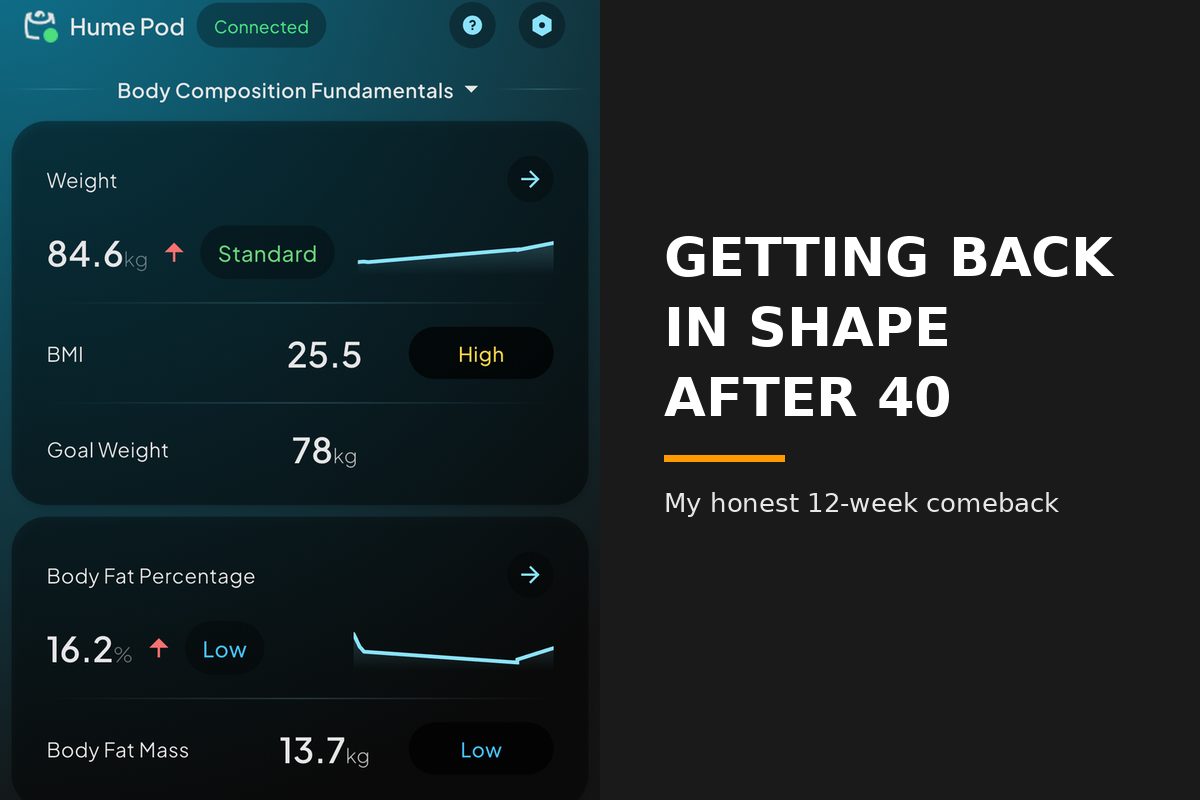
Quick gear note: the scan comes from a Hume Pod, a bioimpedance smart scale whose app splits bodyweight into muscle, fat, water, and per-segment data, with trend charts over time. No sponsorship; the link is an Amazon affiliate link, and I simply own it and use it.
| Metric | What I feared | What the scan said |
|---|---|---|
| Weight | “Back to 85 kg, back to the start” | 84.6 kg (186 lb), up roughly 1 kg (2.2 lb) since June |
| Body fat | “It’s all fat now” | 16.2%, trending up but far from disaster |
| Skeletal muscle | “Lost the muscle I built” | 43.7 kg (96 lb), still standard-or-better in every segment |
| Visceral fat index | “The dangerous kind piled up” | 7, still rated low |
| Metabolic age | “I’m old now” | 35 years, 12 below my passport age |
| Resting heart rate | (was not even thinking about it) | 94 bpm at midday, the one number that is actually alarming |

Read that table again, because the gap between the 2 columns is the entire point of this post. The subjective story in my head said catastrophe. The objective data says drift: about 1 kg (2.2 lb) of weight, a slow upward bend in the fat curves, falling body water, and an elevated heart rate that has much more to do with stress, caffeine, and bad sleep than with muscle loss. My scale runs bioelectrical impedance, which has known accuracy limits versus a DEXA scan, so I treat the absolute numbers with some skepticism. But trends against your own baseline are exactly what these devices are good for, and the trend says: caught it early.

What the tape measure found (the honest metric)
If the scan was reassuring, the tape measure was not, and this is where I stop the good news. A body composition scale estimates. A tape measure just measures. Mine found the drift precisely where a stressed, under-trained, over-fed 47-year-old stores it: around the middle.
Gear note number 2: the tape is a RENPHO smart measuring tape, retractable with a lock that applies the same tension on every pull, and it sends each reading to its phone app over Bluetooth. That removes the 2 classic tape errors, inconsistent pull and misremembered numbers, for the price of a couple of protein shakes. That is an affiliate link: I earn a small commission on qualifying purchases at no extra cost to you.
My waist at the navel is 96.3 cm (37.9 in). The World Health Organization flags increased cardiometabolic risk for men above 94 cm (37 in), and my waist-to-hip ratio sits at 0.98, right at the edge of the abdominal obesity threshold of 1.0. Let that sink in: a man with a metabolic age of 35, 16% body fat, and visible muscle can still carry a waistline in the risk zone. The scale said “fine”. The tape said “fix this”. This is why I measure both, and why my no-BS guide to fitness tracking puts a 2 EUR tape measure above most 300 EUR gadgets.
Here is my complete tape baseline, published so the monthly check-ins have a public starting line:
| Measurement | Baseline (Aug 9, 2026) | 12-week direction |
|---|---|---|
| Bodyweight | 84.6 kg (186 lb) | → 80-81 kg (176-179 lb) |
| Waist (navel) | 96.3 cm (37.9 in) | → under 94 cm (37 in), the priority |
| Chest | 111.1 cm (43.7 in) | hold |
| Shoulders | 97.1 cm (38.2 in) | hold |
| Right / left biceps (flexed) | 34.1 / 33.4 cm (13.4 / 13.1 in) | hold or grow |
| Hips | 98.7 cm (38.9 in) | follows waist |
| Right / left thigh | 52.6 / 52.9 cm (20.7 / 20.8 in) | hold or grow |
| Right / left calf | 35.7 / 35.1 cm (14.1 / 13.8 in) | hold |
| Neck | 39.3 cm (15.5 in) | hold |

Why you lose less muscle than you think after 40
The most useful thing I can tell any man staring at a training gap is this: the damage you imagine is almost always bigger than the damage that happened, and the science backs it up. A 2022 meta-analysis on resistance training cessation in older adults found that meaningful muscle size loss takes substantially longer than most people assume, and much of the early scale movement is glycogen and water, not tissue.
Even better: the muscle you built does not just disappear, it leaves infrastructure behind. Research on so-called muscle memory shows that the extra myonuclei your fibers gained during years of training persist through detraining periods, and 2024 evidence in The Journal of Physiology supports long-term cellular adaptations that make retraining faster than training the first time. In plain language: a trained 47-year-old restarting is not a beginner. He is a veteran re-opening a factory that still has the machines installed.
This is why getting back in shape after 40 is a fundamentally different problem than getting in shape for the first time after 40. The first-timer is building. The returner is reactivating, and reactivation is faster, provided you do not injure yourself in week 1 by training like it is still May. That last part is where the plan comes in. And if you want the deeper science on what your muscle can still do at this age, my post on what research actually shows about muscle growth after 40 covers it.
My 12-week plan for getting back in shape after 40
Here is the exact plan I started this week. It is built on everything the data above says: protect the muscle, attack the waist, fix the recovery basics, and re-enter gradually because the connective tissue of a 47-year-old does not care how strong he used to be.
Weeks 1-2: re-entry, ego parked
3 full-body sessions per week, compound lifts only, at loads around 60-70% of my pre-break working weights, stopping every set 2-3 reps short of failure. The goal of these 2 weeks is not progress. It is re-teaching movement patterns, waking up connective tissue, and clearing the soreness debt without a single heroic set. Research on retraining says the strength comes back fast. Injuries in week 1 are how comebacks die.
Weeks 3-12: rebuild with a deload every 4th week
From week 3, a 4-day upper/lower split with progressive overload, and a planned deload in weeks 4, 8, and 12. At 47, deloads are not optional weakness weeks. They are when the adaptation actually consolidates, and skipping them is how a good comeback turns into a 6-week overuse injury. Cardio is 2 weekly zone 2 sessions of 30-40 minutes, mostly brisk incline walking, aimed directly at the waistline and at bringing that 94 bpm heart rate back to earth.
Nutrition: protein first, deficit second
Protein at 1.8 g per kg of bodyweight, about 150 g per day at my current weight, spread over 4 meals. Calories at a moderate deficit of 300-400 kcal below my measured 1,857 kcal basal rate plus activity. No crash cut. I wrote an entire post about why crash diets destroy muscle in men over 40, and the whole point of this comeback is keeping the 43.7 kg (96 lb) of muscle that survived the break.
Recovery guardrails: sleep and the caffeine cutoff
That midday heart rate of 94 bpm is my stress bill arriving. The 2 guardrails: a hard sleep window of 7+ hours with a fixed wake time, and my own noon caffeine cutoff, which I wrote about in my 5 rules for caffeine after 40 and then spent 3 stressed months ignoring. Morning Nocco stays. Anything after 12:00 goes. I will report the heart rate trend in every check-in as the honesty metric for this section.
The weekly measurement protocol
Every Sunday morning, fasted, before anything else: bodyweight, then 7 tape measurements (shoulders, chest, both arms flexed, waist at navel, mid-thigh, calf), plus a monthly full scan and progress photos. 10 minutes per week. Same time, same conditions, so the deltas mean something. Weight can lie week to week. The combination of scale plus tape plus photos cannot lie for long. Every check-in gets published on the comeback log, a live page tracking this rebuild week by week.
The scoreboard I am actually using this time
I am formally retiring the number 70. The 2021 photoshoot version of me is a photograph, not a target. The scoreboard for this comeback, in priority order: waist under 94 cm (37 in), bodyweight drifting toward 80-81 kg (176-179 lb) while every muscle measurement holds, morning heart rate trending down, and 4 training sessions per week actually completed. That last one is the only metric I fully control, which is exactly why it is on the board.
If you take one thing from this post, take the method, not my numbers: measure your real baseline this Sunday, publish it somewhere you cannot quietly delete (a note to a friend works fine), pick a scoreboard with at most 4 numbers, and make only 1 of them the scale. Getting back in shape after 40 is not a motivation problem. It is a measurement problem wearing a motivation costume.
Frequently asked questions
How long does getting back in shape after 40 take after a 3-month break?
Faster than getting there the first time. Thanks to muscle memory, most returning lifters recover the bulk of lost strength and size within 6-10 weeks of consistent training, roughly half the time the original gains took. Cardiovascular fitness and body composition typically need 8-12 weeks of consistent work to show meaningful change.
How much muscle do you actually lose in 3 months off?
Less than you fear, especially if you stayed generally active. Studies show measurable strength loss starts around weeks 3-4 of complete inactivity, but much early size change is glycogen and water. My own scan after 3 months of minimal training still showed 43.7 kg (96 lb) of skeletal muscle, essentially intact from years of prior training.
Should you restart at the weights you used before the break?
No. Start at 60-70% of your previous working weights for 2 weeks, leaving 2-3 reps in reserve on every set. Your muscles remember faster than your tendons and joints adapt. The single most common comeback killer for men over 40 is loading week-1 sessions like nothing happened.
What should you measure first: scale, tape, or body fat percentage?
All 3, but trust them in this order: tape first, photos second, scale third. A waist measurement at the navel is the cheapest, most honest health metric a man over 40 owns. The WHO risk threshold for men is 94 cm (37 in). Body fat percentage from home scales is best used as a trend, not an absolute truth.
Cardio or weights first when coming back?
Weights first, cardio alongside. Resistance training protects the muscle that keeps your metabolism young, while 2-3 weekly zone 2 sessions handle heart rate, stress, and the waistline. After 40 the order matters: muscle is the asset, cardio is the maintenance.
Final thoughts
3 months ago I would have told you I was one bad summer away from losing everything I built since 42. The data says otherwise: 1 kg (2.2 lb) of drift, muscle intact, metabolic age still 35, and one waist measurement that needs 12 focused weeks. The gap between the story in my head and the numbers on the screen is the whole lesson. Your brain keeps score with old anchors. Instruments keep score with reality. When life knocks you down for a season, and after 40 it will, do not negotiate with the mirror or the memory of your best shape. Take 20 measurements on a Sunday morning and negotiate with those instead.
Every Sunday from now on, my numbers go up on the comeback log. First full monthly check-in lands in early September, same numbers, same table, no excuses. If you are restarting too, measure your baseline this Sunday and start 2 gears below your ego. I will see you in the data.
References
- Coleman, M., et al. (2022). Use It or Lose It? A Meta-Analysis on the Effects of Resistance Training Cessation (Detraining) on Muscle Size in Older Adults. International Journal of Environmental Research and Public Health, 19(21), 14048.
- Psilander, N., et al. (2019). Effects of training, detraining, and retraining on strength, hypertrophy, and myonuclear number in human skeletal muscle. Journal of Applied Physiology, 126(6), 1636-1645.
- Cumming, K. T., et al. (2024). Muscle memory in humans: evidence for myonuclear permanence and long-term transcriptional regulation after strength training. The Journal of Physiology, 602(17), 4171-4193.
- Bickel, C. S., Cross, J. M., & Bamman, M. M. (2011). Exercise dosing to retain resistance training adaptations in young and older adults. Medicine & Science in Sports & Exercise, 43(7), 1177-1187.
- World Health Organization. (2011). Waist circumference and waist-hip ratio: report of a WHO expert consultation. Geneva: WHO.
Follow the comeback, weekly
One email per week. Real protocols, real numbers, no hype, written by a 47-year-old rebuilding in public. Plus: my free body transformation blueprint PDF.




Leave a Reply