
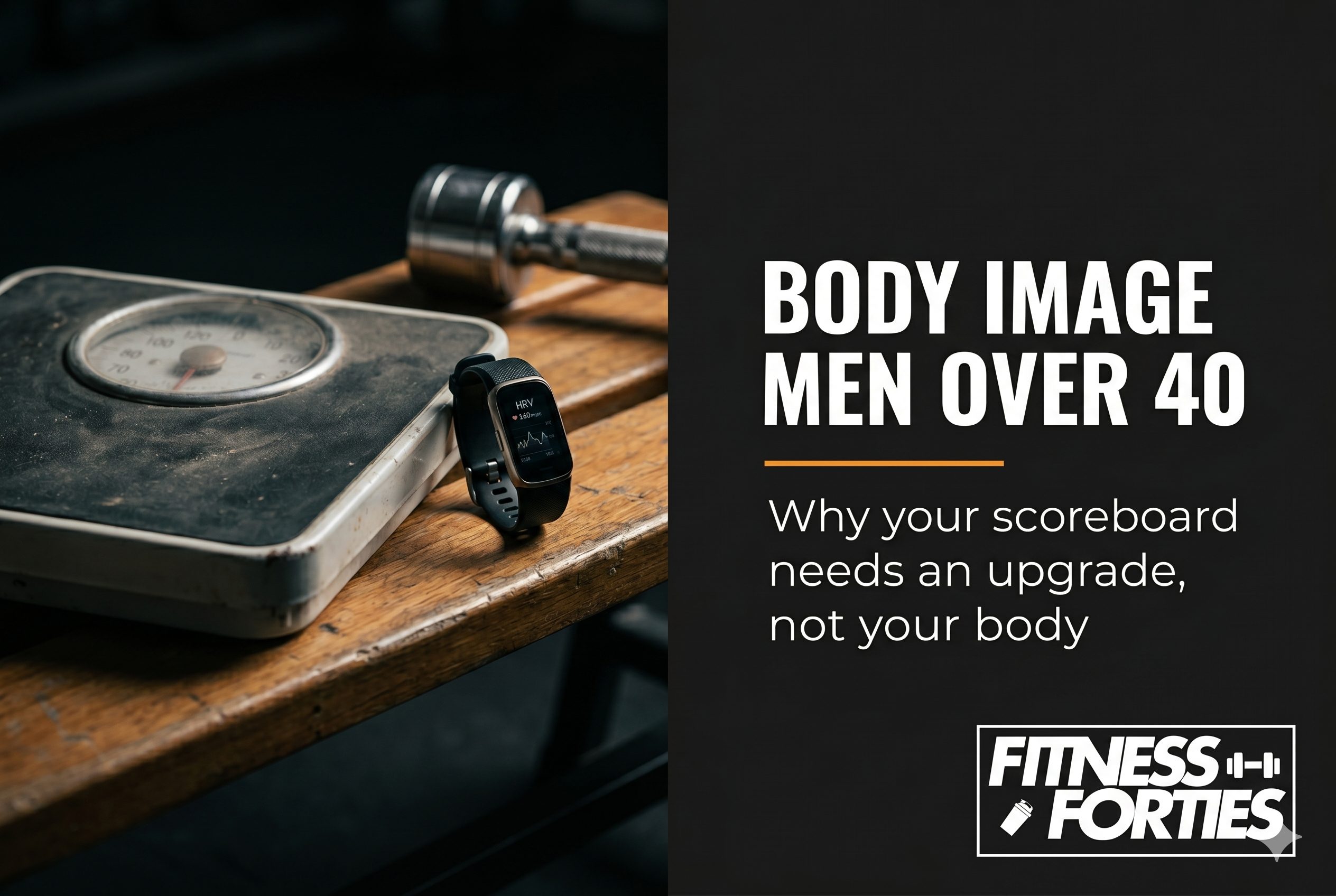
Quick Summary:
- Body image men over 40 is not a body problem. It is a scoreboard problem. The mental health risk that takes most guys out of training is not loss of strength. It is the gap between an outdated scoreboard (1-rep max, 6-pack abs, 25-year-old recovery times) and what their body is actually optimizing for now.
- A multi-metric scoreboard (strength PRs, HRV, grip strength, body fat %, sleep, RHR) consistently shows that men in their 40s and 50s are routinely setting lifetime bests on at least 3 of the 6 dimensions, even when the bench press has plateaued.
- The reframe is not “accept what you cannot do.” It is the opposite: most men over 40 leave the best version of themselves on the table because they keep grading themselves on a metric that stopped being the right one a decade ago.

Table of contents
- Why most men over 40 quit training (it is the scoreboard, not the body)
- The performance trap: when self-worth equals bench numbers
- What strong actually looks like for body image men over 40
- The 6 metrics that should replace the mirror after 40
- The 2-minute mental reframe before each workout
- How to rebuild a healthier body image without losing intensity
- Comparison: the old scoreboard vs the upgraded one
- Frequently asked questions
- Final thoughts
- References
Why most men over 40 quit training (it is the scoreboard, not the body)
Most men who quit training in their 40s do not quit because their body broke. They quit because their scoreboard broke. The bench press number stops climbing the way it used to. The morning mirror does not reward 4 hard sessions per week the way it did in college. Recovery from a heavy leg day takes 3 days instead of 1. Each of these signals is read as failure when it is actually data, and the cumulative weight of feeling like you are losing at your own game pushes men out of the gym entirely.
This is the body image trap for men over 40. The body is doing exactly what a healthy adult body should do. It is the metrics being applied to it that have gone stale. A 45-year-old man trying to grade himself on the same 4 indicators he used at 22 (max strength, low body fat, fast recovery, mirror) is grading himself with a tool built for someone else. The right answer is not to abandon the standards. It is to update them.
This is not a softening of the bar. The bar gets higher. A 45-year-old who is genuinely strong (say, a 1.5x bodyweight bench, sub-18% body fat, 50+ HRV, 50 kg grip strength, 7+ hour sleep average, sub-65 RHR) is operating at a level that crushes the 22-year-old version of himself on every metric except raw absolute strength, and even that gap is much smaller than the cultural narrative says.
The performance trap: when self-worth equals bench numbers
The Italian psychologist Corena Pezzella made an observation in Men’s Health that lands hard for men over 40: for many men, the body is not just biological. It is a symbolic reference for strength, control, and reliability. When the body’s outputs change (slower recovery, faster fatigue), it triggers a quiet identity crisis. Some men respond with frustration, others with hyper-control, others with pushing past sensible limits to “prove they can still do it.”
The diagnostic test is simple: if you would rate yourself a worse man because your bench dropped 5 kg, your scoreboard is too narrow. The fix is not to stop caring about the bench. It is to widen the lens so that one number does not control your sense of self. This is the body image work that matters for men over 40, and it is mental health work as much as physical health work.
In practice, the men who train consistently into their 50s and 60s have one thing in common: they grade themselves on a basket of 5-7 metrics, not on 1. When one metric goes sideways for a quarter (strength plateau, body fat creeps up after a vacation, HRV drops during a stressful work cycle), the other 4-6 keep them anchored. The week-to-week emotional swing flattens. Compliance goes up. Results follow. For the underlying motivation work, see our midlife fitness motivation guide for men over 40.
What strong actually looks like for body image men over 40
If body image men over 40 needs a new visual reference, it is not the bodybuilder pose. It is the multi-dimensional athlete. Think of the 50-year-old who can deadlift 2x bodyweight, run a sub-25 minute 5K, do 15 strict pull-ups, holds a 60+ HRV, and sleeps 7.5 hours nightly. He is not the strongest person in any single category. He is the most athletically resilient person across all of them. That profile is achievable for the vast majority of men over 40 who train deliberately for 18-24 months.
This is why the FitnessForties premise has always been that the best fitness years for most men are still ahead, not behind. At 25, you can specialize and beat your future self in 1 dimension (say, max bench or 100m sprint). At 45, you can compound across 6 dimensions and beat your past self in every category that actually predicts how the next 30 years go. The math favors the older athlete who is willing to update his scoreboard.
The science supports this. Aerobic capacity peaks at 25 but stays trainable into the 70s. Maximum strength peaks around 30 but most men are nowhere near their genetic ceiling at 45 because they never trained seriously in their 20s. HRV, grip strength, and resting heart rate are all directly improvable at 45, 55, and 65 with consistent training and recovery. The pillars are covered in strength training for longevity: why men over 40 need to focus on power and the muscle science in muscle growth after 40.
The 6 metrics that should replace the mirror after 40
For body image men over 40, the mirror is the worst possible metric for body image men over 40. It is non-linear, emotionally noisy, lighting-dependent, and lags real progress by weeks. The replacement is a 6-metric dashboard that measures inputs and outputs you can actually move:
- Strength PRs in 2-3 main lifts. Bench, squat, deadlift, row, weighted pull-up. Track in 4-week rolling windows. A climbing PR trend is the single best signal that training is working.
- HRV (7-day rolling average). A trending HRV is the leading indicator of recovery and stress balance. Apple Watch, Whoop, Garmin, or Oura all work. Trend matters more than absolute number.
- Grip strength (kg). Test once per quarter with a hand dynamometer. After 40, grip strength is one of the strongest independent predictors of healthspan. Below 35 kg in middle age is a red flag.
- Body fat percentage (DEXA quarterly, calipers monthly). Far better than weight alone. Tracks the muscle-to-fat ratio that body image actually responds to.
- Sleep duration (7-day rolling average). 7.5 hours is the floor for serious training. Below that, recovery and gains compound badly.
- Resting heart rate. A 3-5 bpm drop over 12 weeks indicates real aerobic adaptation. Cheap, free, daily.
A man who scores green on 5 of 6 of these metrics is in elite fitness territory for his age, regardless of what the mirror says on a Tuesday morning. The framework for which numbers actually predict progress is in our fitness tracking guide for men over 40.
The 2-minute mental reframe before each workout
The cognitive habit that protects body image men over 40 from the mirror trap is repeated before training, not after. It takes 2 minutes:
- Name the scoreboard. Say to yourself the 6 metrics you grade on. Out loud or written.
- Pick this session’s score. “Today I am scoring on [strength PR / volume / HRV-friendly intensity / sleep-supporting timing].” Just 1. The other 5 metrics are not graded today.
- Detach mirror from session. This session does not get judged by how the mirror looks tomorrow. It gets judged by whether the chosen score moved.
- Define done. “Done is [3×5 at 100 kg / 12 hard sets across chest / RPE 7 average across all working sets].” Done is not “until I feel destroyed.”
This 2-minute pattern protects the mental health side. It also tends to produce better-quality sessions because the goal is binary (did I hit it or not) rather than emotional (did I feel strong today). Sleep, cortisol, and life stress vary day to day. The score does not. Before harder sessions, layer in the recovery foundation from sleep optimization blueprint for men over 40 and the cortisol controls from cortisol stress management for men over 40.
How to rebuild a healthier body image without losing intensity
The trap to avoid is reading “wider scoreboard” as “softer training.” It is the opposite. When you stop grading yourself on a single number, the freed-up emotional energy goes back into intensity in the gym. The men who let go of the mirror obsession typically train harder, not less hard, because they stop having the bad-mirror-day → skip-session loop.
3 principles tend to anchor the rebuild:
Train for the next 30 years, not the next 30 days. Every session is one deposit into a longevity account. Some weeks you make a big deposit (heavy strength block). Some weeks you make a smaller deposit (deload, mobility, Zone 2). Both count. The aggregate over a decade is what compounds. This is the same logic we apply to building muscle after 40 where the slow, consistent build beats the boom-bust cycle every time.
Keep the standards high but adaptive. Hard but achievable. A 45-year-old should be able to bench 1.2-1.5x bodyweight, deadlift 2x, run a 5K under 28 minutes, and hold a 50+ HRV with consistent training. These are not “considering your age” standards. They are absolute standards that most untrained 25-year-olds cannot hit either. Aim for them.
Replace mirror time with measurement time. Once a quarter, take front/side/back photos in standard lighting. Compare quarter to quarter, not day to day. The visual change becomes obvious on quarterly cadence and invisible on daily cadence. The same photos used wrong (every morning) become a body image weapon against you.
Comparison: the old scoreboard vs the upgraded one
| Old scoreboard (under 30) | Upgraded scoreboard (over 40) | Why the upgrade |
|---|---|---|
| Single 1-rep max (bench) | PR trend across 3 main lifts (4-week rolling) | Captures balanced strength, less injury risk |
| Body weight on the scale | Body fat % + waist (cm) + lean mass | Mass alone is meaningless without composition |
| Daily mirror check | Quarterly photos (standard lighting) | Removes daily emotional noise |
| Sets/reps completed | RPE per set, total weekly hard sets | Quality of stimulus matters more |
| “Did I feel strong?” | HRV trend, sleep duration, RHR | Objective signals beat subjective feel |
| Visual abs at all times | Grip strength + 5K time + HRV + body fat band | Predicts 30-year healthspan |
Frequently asked questions
Is body image men over 40 really a mental health issue?
Yes. Body image distress in midlife men is increasingly documented in the clinical literature, with rising rates of muscle dysmorphia, exercise dependence, and depressive symptoms tied to perceived loss of physical capacity. The protective factor is the same as in younger men: tying self-worth to a wider basket of measures, not a single number.
How do I know if my scoreboard is too narrow?
If a single bad gym session, a single mirror check, or a single bodyweight reading can derail your mood for the day, your scoreboard is too narrow. Healthy men over 40 treat individual data points as data, not as judgments.
Should I stop weighing myself?
No, but weigh as a 7-day rolling average, not a daily reading. Daily weight swings of 1-2 kg (2-4 lbs) on water alone create false signals. Trend matters; daily readings do not.
What if my bench really is dropping at 45?
If a real strength regression is happening, treat it as a diagnostic signal, not a verdict. The 3 most common drivers in men over 40 are: under-recovery (sleep, stress), hidden hormonal issue (test bloodwork, not assumption), or programming that no longer matches your recovery capacity. Run a 4-week deload + sleep priority block before assuming the body is the problem.
Does training harder help body image at 40+?
Indirectly, yes. The stronger driver of body image improvement is competence (strength PRs, conditioning improvements) rather than aesthetics. Men who chase aesthetics first usually end up with worse body image outcomes than men who chase capability first and accept aesthetics as a byproduct.
How long does the scoreboard upgrade take to feel different?
Most men report feeling a measurable shift in 6-8 weeks. The pattern: weeks 1-2 feel awkward (the old scoreboard pulls back). Weeks 3-4 the new metrics start to register as wins. Weeks 5-8 the body image baseline starts to shift because the wins are stacked across multiple dimensions.
Final thoughts
The hardest mental rep in the body image men over 40 conversation is letting go of the scoreboard that built them in their 20s. It served a purpose then. It is sabotaging them now. The body has not betrayed them. The grading rubric stopped fitting the work.
The upgrade is not a downgrade dressed up. It is a real expansion of what counts as winning. A 50-year-old who is in the top 10% on grip strength, HRV, and 5K time for his age is winning at the parts of fitness that actually predict whether he is the 99-year-old still walking up stairs. A 50-year-old whose only metric is “do I have abs today” is going to lose every Tuesday morning for the next 30 years.
Pick your 6 metrics. Train for them. The body image work takes care of itself once the scoreboard is right.
References
- Pezzella, C. (2026). The body and identity: rediscovering that strength is not only performance but also adaptability. Men’s Health (Italian edition), May 2026.
- Strain, T., et al. (2018). Use of the prevented fraction for the population to determine deaths averted by existing prevalence of physical activity: a descriptive study. The Lancet Global Health, 8(7), e920-e930.
- Volaklis, K. A., Halle, M., & Meisinger, C. (2015). Muscular strength as a strong predictor of mortality: A narrative review. European Journal of Internal Medicine, 26(5), 303-310.
- Murray, A., et al. (2017). The relationship between subjective and objective measures of physical fitness in middle-aged men. Journal of Aging and Physical Activity, 25(2) , 234-240.
- Lavender, J. M., et al. (2017). Men, muscles, and eating disorders: an overview of traditional and muscularity-oriented disordered eating. Current Psychiatry Reports, 19(6), 32.
- Tylka, T. L., & Wood-Barcalow, N. L. (2015). What is and what is not positive body image? Conceptual foundations and construct definition. Body Image, 14, 118-129.
- Sabiston, C. M., et al. (2019). Body image, physical activity, and sport: A scoping review. Psychology of Sport and Exercise, 42, 48-57.
Get my free body transformation blueprint
My Body Transformation Blueprint: the exact 4-phase framework I used to drop 14 kg (31 lb) of body fat as a busy man over 40. Enter your email and I will send you the PDF straight away.
No spam. Unsubscribe in 1 click. Privacy-first and GDPR compliant.


Leave a Reply