
Quick Summary:
- Adults aged 40-60 can simultaneously build muscle and lose fat with resistance training and 1.6 g/kg of protein, and 8 weeks is enough to produce a visible body recomposition before summer 2026.
- Men lose roughly 7.5% of their strength every 5 years between ages 40 and 50, and grip strength below 35 kg predicts higher all-cause mortality risk after 40, so muscle is a longevity asset, not a vanity project.
- Pure cardio cuts and GLP-1 weight loss can pull up to 39% of “lost” weight from lean mass, but resistance training 3 times per week paired with 1.6-2.2 g/kg of protein preserves 90% or more of muscle mass during a deficit.

- Why the standard summer body advice fails men over 40
- The science: why muscle matters more than the mirror
- How much muscle can you actually build in 8 weeks after 40?
- The 8-week build muscle for summer protocol
- Comparison: 3 ways to build muscle for summer after 40
- What to track over 8 weeks
- Frequently asked questions
- Final thoughts
- References
Why the standard summer body advice fails men over 40
A reel went viral on Instagram last week showing a 99-year-old man training in a commercial gym, reposted by Joey Swoll with the caption “99 years young and looking AMAZING.” It racked up 124,000 likes in days. The clip is a useful reframe right now, because today is May 14 and summer holidays are roughly 8 weeks away. Half the fitness internet is shouting about getting “shredded for summer” in 6 weeks. The 99-year-old in that reel is a quiet rebuke to all of it.
The standard summer body playbook for men over 40 looks the same every year: cut calories hard, do more cardio, hope the abs surface in time for the beach. It is a strategy built for 22-year-olds, and it punishes men in their 40s in 3 ways. First, aggressive deficits accelerate muscle loss at exactly the age when muscle is hardest to keep. Second, the post-summer rebound usually overshoots the starting point. Third, even when it works visually, what is left in September is a smaller, weaker, more metabolically fragile version of the body you started with.
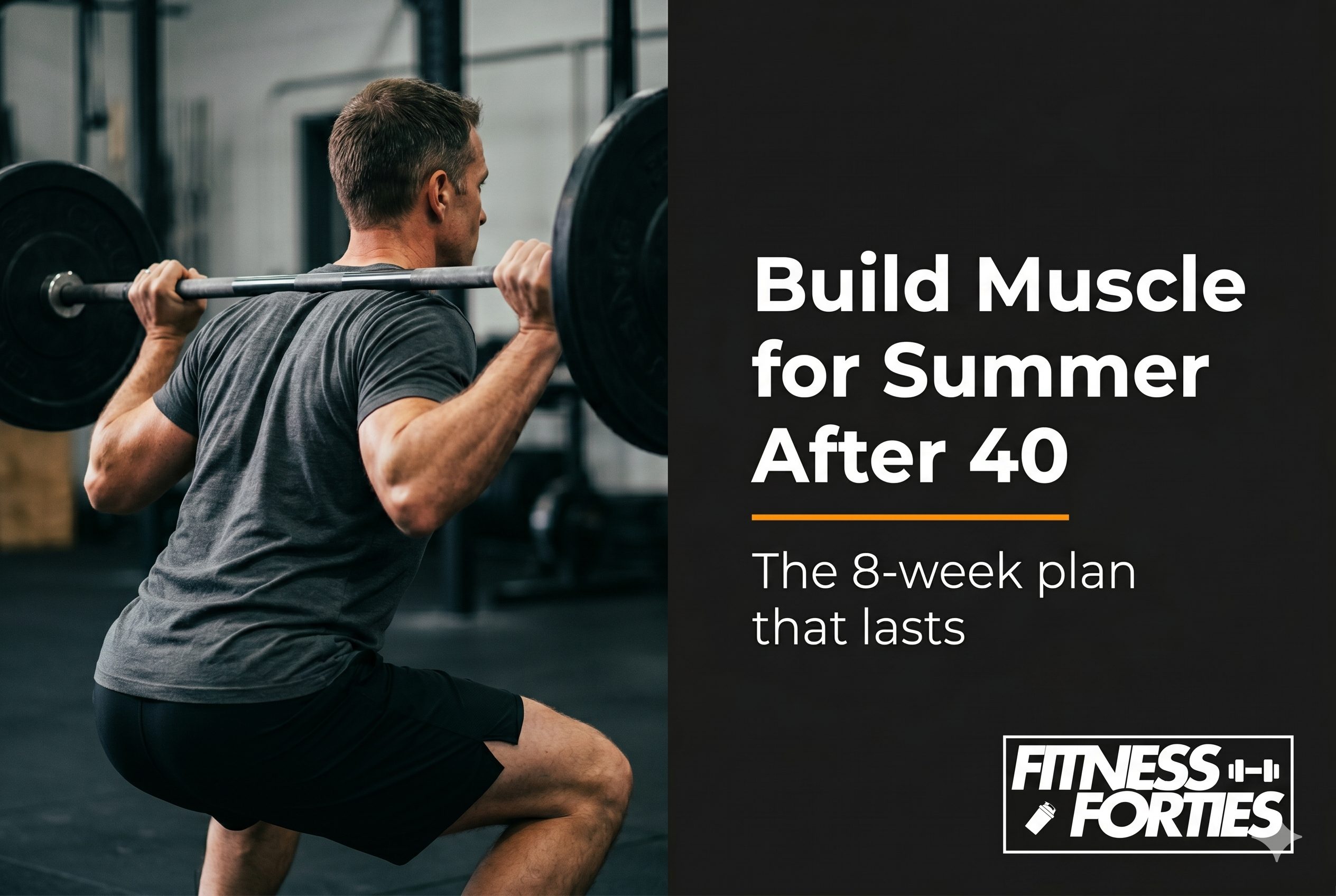
If you want to build muscle for summer after 40, the standard summer cut is the wrong tool. Men over 40 do not need a summer body. They need a build that holds up in August, in February, and at 65. The good news: you can absolutely look better with your shirt off in 8 weeks. The mechanism just has to be muscle gain plus fat loss, not fat loss alone. That changes everything about how you train, eat, and recover between now and July.
The science: why muscle matters more than the mirror
Three converging data points make muscle the single most important investment a man over 40 can make. None of them are about aesthetics.
Sarcopenia starts in the fourth decade. Skeletal muscle mass and strength begin to decline around age 40, with men losing roughly 7.5% of their strength every 5 years between ages 40 and 50, accelerating to about 15% per decade after 50. Without resistance training, the average man loses 3% to 5% of his muscle mass per decade after age 30, and up to 8% per decade after 65. The mass loss is invisible for years; the function loss shows up as bad knees, lost grip, slower stairs.
Grip strength predicts how long you live. Multiple cohort studies have found that low muscle strength is independently associated with higher all-cause mortality, even after adjusting for physical activity and total muscle mass. In one analysis of men over 90, grip strength of 15 kg (33 lbs) was linked to elevated mortality risk, while 35 kg (77 lbs) was protective. The takeaway is brutal: the rate of strength loss in middle age, not your body weight, is the better predictor of how the next 30 years go.
Muscle is your metabolic insurance policy. Higher skeletal muscle mass is associated with better insulin sensitivity and a significantly lower prevalence of metabolic syndrome, independent of body fat. Skeletal muscle is the largest site of glucose disposal in the body, so when it shrinks, blood glucose control gets worse. We covered the practical fallout in our blood glucose strategies for men over 40.
The GLP-1 lesson nobody talks about. The Ozempic era exposed something the fitness world already knew: when you lose weight without resistance training and adequate protein, up to 39% of what you lose is lean mass, not fat. The same physiology applies to a crash summer cut. A 2023 trial found that GLP-1 users who added resistance training plus high-protein intake preserved 80-85% of weight lost as fat, while sedentary users only got to 60%. Translation: the lever that protects muscle on Ozempic is the same lever that protects muscle in any deficit, drug or no drug. Our deeper take is in crash diets after 40: why they destroy muscle.
Put together, these 4 facts mean a “summer body” approach that treats muscle as collateral damage is not just shortsighted. It actively accelerates the curve that ends with you not being the 99-year-old in the gym.
How much muscle can you actually build in 8 weeks after 40?
When you set out to build muscle for summer after 40, the math has to be realistic. This is the question that wrecks most plans. People either expect too much (a Hollywood transformation in 60 days) or too little (giving up because progress feels slow). The realistic answer for a trained man in his 40s is 0.5-1.0 kg (1-2 lbs) of new muscle in 8 weeks, paired with 2-4 kg (4-9 lbs) of fat loss if nutrition is dialed in. For a previously untrained man, the gain can be 1.5-2 kg (3-4 lbs) of muscle in the same window.
That sounds modest written down. Visually, it is not. A kilogram of muscle redistributed across shoulders, chest, and arms, combined with even a modest cut in waist circumference, is what changes how a t-shirt fits and what shows up in a beach photo. The gain-to-loss ratio is what creates the optical illusion called body recomposition. The scale barely moves. The mirror moves a lot.
Two conditions have to be true for this to work in 8 weeks. The deficit has to be small enough that protein synthesis still functions, generally no more than 300-500 kcal below maintenance. And the training stimulus has to be heavy enough and frequent enough to give the muscle a reason to grow. We unpack the recomp mechanics in detail in our muscle growth after 40 science guide.
The 8-week build muscle for summer protocol
This is the framework to build muscle for summer after 40. Adapt the specific lifts and meal structure to your situation, but the levers and dosages are non-negotiable.
Training: 3 to 4 resistance sessions per week, compound-first
Resistance training drives the muscle growth signal. Cardio supports recovery and fat loss but does not build the body shape. After 40, total weekly hard sets per muscle group matters more than session frequency, but most lifters do better with 3-4 strength sessions weekly than with 5-6, which tend to compromise recovery.
Structure each session around 1-2 compound lifts at 4-6 reps, then 2-3 accessory exercises at 8-12 reps. Push, pull, legs is the simplest split for 3 days. Upper/lower for 4 days. Keep total weekly sets per muscle group between 10 and 20. Research on older trained adults suggests doubling sets from 3 to 6 per exercise can boost muscle protein synthesis by over 100% compared to lower volume, but recovery has to support the volume or the math breaks down.
For a deeper structural framework, our building muscle after 40 simple 5-move plan is a good starting template. For the bulking-phase mechanics if you want to extend past summer, see bulking after 40: complete guide to lean muscle gain.
Nutrition: 1.6-2.2 g of protein per kg of bodyweight, slight deficit
Protein is the single most important nutritional lever for body recomposition after 40. The current evidence converges on 1.6-2.2 g/kg of bodyweight per day, ideally distributed across 4 meals of 0.4 g/kg each. For an 85 kg (187 lbs) man, that is 136-187 g of protein daily, in roughly 35-45 g doses. Hit this and the math of recomposition starts to function.
Caloric strategy is a slight deficit, not a starvation cut. Aim for 250-500 kcal below maintenance for the 8 weeks. Larger deficits compromise muscle protein synthesis and tank training output. Fill the rest of the calories with whole-food carbs around training and at least 0.8 g/kg of fat from nuts, olive oil, eggs, and oily fish.
Whey or casein are useful for hitting the protein target without overshooting calories. We compared the leading options in our best protein powder for men over 40 buying guide.
Recovery: 7-9 hours of sleep, HRV-guided deload
The recovery side of the equation is where men over 40 most often break the protocol without realizing it. Sleep is the lever. Aim for 7-9 hours nightly with consistent sleep and wake times. Sleep loss directly suppresses testosterone, growth hormone, and protein synthesis, and elevates cortisol, which favors fat storage. One bad week of sleep can erase 2 weeks of training.
Track HRV trends, not single readings. A sustained 7-day downtrend is the signal to deload, not push through. The sleep optimization blueprint for men over 40 covers the specific levers that move the needle most.
Cardio: Zone 2 plus minimal HIIT
Cardio belongs in the plan, but as the supporting actor. Two to three Zone 2 sessions per week of 30-45 minutes each (brisk walking, cycling, rucking, easy rowing) builds the aerobic base that supports recovery between strength sessions, improves insulin sensitivity, and accelerates fat loss without eating into recovery. One short HIIT session per week is plenty if you want it; more than that competes with strength gains.
Rucking is the cardio modality I recommend most often to men over 40 because it doubles as low-impact strength work for posture, glutes, and core. The case is in rucking for men over 40: the best Zone 2 cardio in 2026.
Comparison: 3 ways to build muscle for summer after 40
Most men reach for one of three approaches when summer panic hits. They are not equivalent.
| Strategy | Mechanism | Muscle outcome | What August looks like | What February looks like |
|---|---|---|---|---|
| Pure cut (aggressive deficit + cardio) | 500-1000+ kcal deficit, daily cardio, often low protein | Up to 30-40% of weight lost is lean mass | Lighter, weaker, looks “deflated” | Rebound past starting weight, lower muscle baseline |
| GLP-1 weight loss alone | Appetite suppression, no training adjustment | Up to 39% of weight loss from muscle, “Ozempic face” | Significant scale drop, sagging skin, low energy | Weight regain risk if discontinued, permanent muscle deficit |
| Body recomposition (this plan) | Resistance 3-4x/week, 1.6-2.2 g/kg protein, slight deficit | +0.5-2 kg lean / -2-4 kg fat, 90%+ muscle preserved | Visibly leaner, stronger lifts, better posture | Compounding strength and metabolic health, sustainable |
The first two strategies optimize for August. The third optimizes for the next 30 years. Both can produce a beach photo. Only one builds the foundation that gets you to 99.
If you are weighing fat-loss-first vs muscle-first for the next 8 weeks, our fat loss after 40: a proven 6-step guide lays out when to pick which lever.
What to track over 8 weeks
The mirror is the single worst metric for body recomposition. Visual change is non-linear and emotionally noisy, especially in week 3 when the scale plateau hits. Track these instead:
- Strength PRs in 2-3 main lifts. If your bench, squat, and row numbers are climbing, you are building muscle, full stop.
- Bodyweight as a 7-day rolling average. Daily weights swing 1-2 kg (2-4 lbs) on water alone. The trendline is what matters.
- Body fat percentage at week 0 and week 8. Use DEXA if you can. Calipers or bioimpedance work if measurements are taken under the same conditions both times.
- Waist circumference at the navel. A loss of 2-3 cm (0.8-1.2 in) over 8 weeks is meaningful recomposition even with stable bodyweight.
- Sleep duration and HRV trend. Both are leading indicators of recovery. Falling HRV or shortened sleep is your warning to deload before performance drops.
- Resting heart rate. A drop of 3-5 bpm over the program is a good sign that aerobic base is improving.
For a deeper framework on which numbers actually matter, our fitness tracking guide for men over 40 breaks down 5 metrics that predict real progress.
Frequently asked questions
Can I build muscle for summer after 40 if I am in a calorie deficit?
Yes, especially if you are not currently training near maximal volume or you are returning to lifting after a layoff. Trained natural lifters in their 40s can expect modest body recomposition (0.5-1 kg of muscle gain alongside 2-4 kg of fat loss in 8 weeks) when protein hits 1.6-2.2 g/kg and the deficit stays moderate. Untrained or returning lifters can do significantly better. Beyond about year 2 of consistent training, dedicated bulk and cut phases produce more total muscle than continuous recomp.
Should I do cardio at all if my goal is muscle?
Yes, but as a supporting activity. Two to three Zone 2 sessions of 30-45 minutes per week improve recovery, insulin sensitivity, and fat loss without compromising strength gains. Avoid stacking long high-intensity sessions on the same days as heavy lifting, and skip running marathons during the 8 weeks.
Do I need testosterone replacement therapy to build muscle after 40?
For most men with normal testosterone in the 12-25 nmol/L range, no. Healthy older men respond well to resistance training and protein without TRT. TRT is a medical intervention for clinically low testosterone, not a shortcut for body composition goals. Sleep, training intensity, and protein move the needle far more than most men assume. Our building muscle after 40: debunking the TRT myth covers what the data actually shows.
What is the minimum training volume that produces results in 8 weeks?
Three full-body sessions per week of 45-60 minutes, with 8-12 hard sets per major muscle group weekly, is enough to drive measurable muscle growth in trained men over 40. Below that, gains slow significantly. The ceiling for productive volume in this age group is around 16-20 sets per muscle group per week.
Is creatine worth it for men over 40?
Yes. Creatine monohydrate at 3-5 g per day is the most evidence-backed supplement for muscle gain and strength performance, and the benefit may be larger in older men because it supports both training output and cognitive function. It is cheap, well-studied, and safe. Hydrate properly when starting it.
Is 8 weeks enough to see a difference shirtless?
For most men over 40 starting from a typical “office body,” yes. 0.5-1 kg of muscle redistributed across upper body and a 2-3 cm waist reduction is visible. The bigger your starting body fat, the more dramatic the visual change in 8 weeks because lower body fat reveals existing muscle that was previously hidden.
Final thoughts
The fastest way to build muscle for summer after 40 and look better at the beach in July is not to crash diet between now and then. It is to build a small amount of new muscle while losing a small amount of fat, and to do it in a way that is still working in February. Your shirt fits better. Your bench is up. Your blood glucose is down. Your grip strength is climbing instead of declining. None of that vanishes when summer ends.
The 99-year-old in that Joey Swoll reel did not get to the gym at 99 by chasing summer bodies in his 40s. He got there by building, year after year, a body that kept showing up. Eight weeks from today, you will either have used this window to deposit into the same account or to withdraw from it. The protocol above is how you deposit. Pick a date in mid-July, write your week-1 lifts in a notebook today, and start.
References
- Distefano, G., & Goodpaster, B. H. (2018). Effects of Exercise and Aging on Skeletal Muscle. Cold Spring Harbor Perspectives in Medicine, 8(3).
- Cruz-Jentoft, A. J., et al. (2019). Sarcopenia: revised European consensus on definition and diagnosis. Age and Ageing, 48(1), 16-31.
- Volaklis, K. A., Halle, M., & Meisinger, C. (2015). Muscular strength as a strong predictor of mortality: A narrative review. European Journal of Internal Medicine, 26(5), 303-310.
- Wirth, J., et al. (2024). Association of Muscle Strength With All-Cause Mortality in the Oldest Old: Prospective Cohort Study From 28 Countries. Journal of Cachexia, Sarcopenia and Muscle.
- Morton, R. W., et al. (2018). A systematic review, meta-analysis and meta-regression of the effect of protein supplementation on resistance training-induced gains in muscle mass and strength in healthy adults. British Journal of Sports Medicine, 52(6), 376-384.
- Schoenfeld, B. J., et al. (2018). Resistance Training Volume Enhances Muscle Hypertrophy but Not Strength in Trained Men. Medicine & Science in Sports & Exercise, 51(1), 94-103.
- Sardeli, A. V., et al. (2023). Effects of resistance training combined with caloric restriction on body composition in older adults: a systematic review. Nutrients, 15(8).
- Wilding, J. P. H., et al. (2021). Once-Weekly Semaglutide in Adults with Overweight or Obesity. New England Journal of Medicine, 384(11), 989-1002.
- Locatelli, J. C., et al. (2024). Incretin-Based Weight Loss Pharmacotherapy: Can Resistance Exercise Optimize Changes in Body Composition? Diabetes Care, 47(4), 506-516.
- Srikanthan, P., & Karlamangla, A. S. (2014). Muscle mass index as a predictor of longevity in older adults. American Journal of Medicine, 127(6), 547-553.
Get my free body transformation blueprint
My Body Transformation Blueprint: the exact 4-phase framework I used to drop 14 kg (31 lb) of body fat as a busy man over 40. Enter your email and I will send you the PDF straight away.
No spam. Unsubscribe in one click. Privacy-first and GDPR compliant.


Leave a Reply