
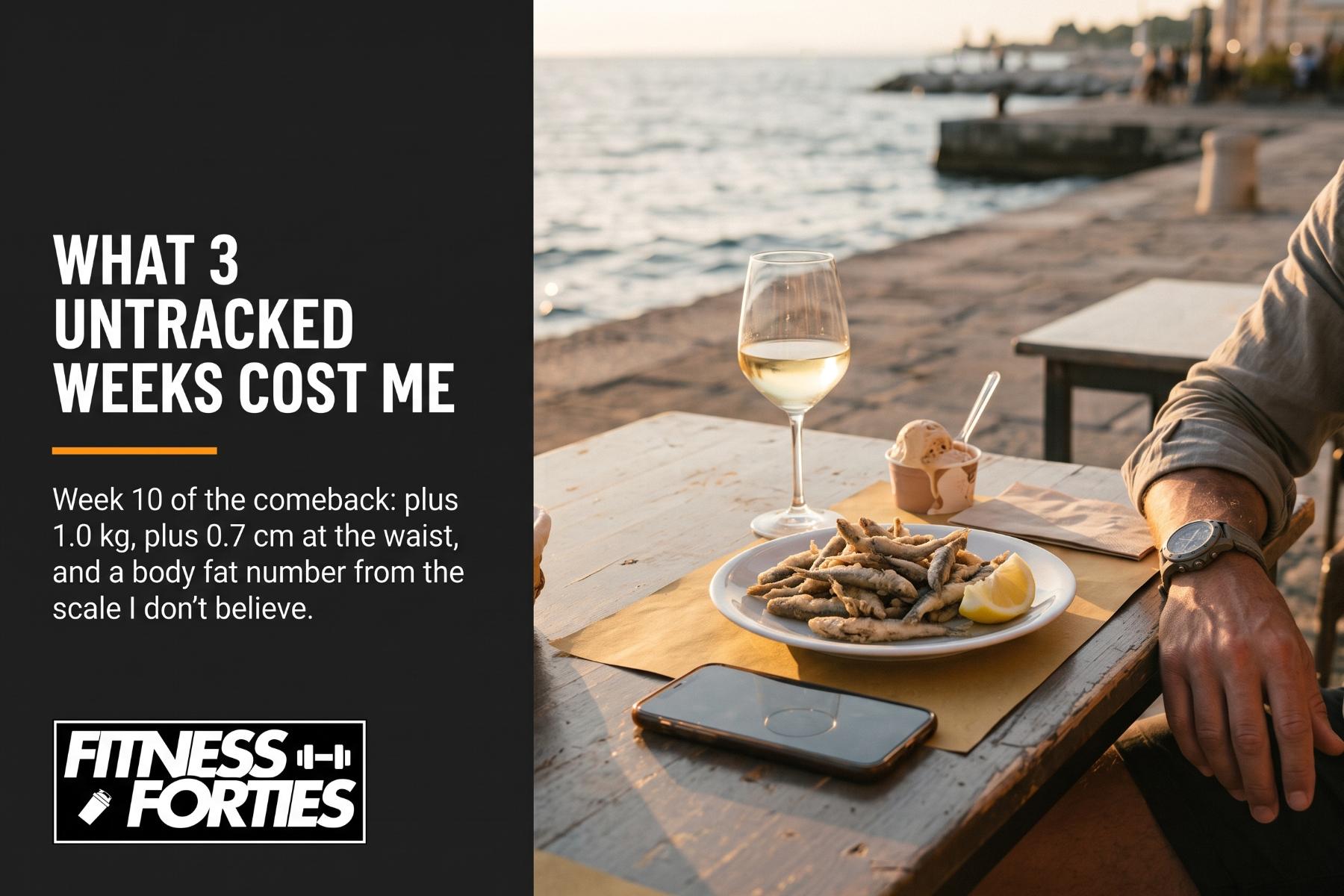
Quick Summary: Week 10 of my comeback, first fasted check-in in three weeks, 18 October: 82.7 kg (182.3 lbs), plus 1.0 on week 7; waist at the navel 93.2 cm (36.7 in), plus 0.7. The scale says body fat fell to 14.1%; I don’t believe it, because body water is flagged high and a bioimpedance scale reads water as lean mass. The real lesson is not the ice cream in Trieste or the wine in Barcelona. It is that three weeks without food tracking after 40 cost me more than the food did: when you can’t weigh ingredients, scan a barcode or control how a dish is cooked, you think you are eating fine and you aren’t. Tracking restarts today.
- Week 10 numbers
- Why I don’t believe the body fat number
- Three weeks of eating out: what actually went wrong
- Does food tracking after 40 really matter more than the occasional treat?
- What a professional bodybuilder says, and what I take from it
- Training with my daughter
- The plan for week 11
- Frequently asked questions
- Final thoughts
- References
New: the FitnessForties Training App. 14 programs for men over 40, deload weeks built in, works with no signal. USD 10, once. See the app
For three weeks I had no scale, no tape and no kitchen. A company event in Barcelona with banquets and wine, then two weeks in Trieste with ice cream and fried fish from the sea in front of me. I ate what was put on the table and I did not log a single meal. This morning I was back on my own bathroom floor, fasted, same scale, same tape, same order.
The numbers are not a disaster. They are a receipt. And the receipt says something I already knew from my first cut years ago and had to relearn the expensive way: food tracking after 40 is the lever, not the sins. One kilo and most of a centimetre came back in three weeks, and the honest reason is not what I ate. It is that I had no idea what I ate.
This post is the week 10 check-in, scored against the same scoreboard as every week, plus the one thing I want to take out of it before week 11 starts. If you are new here, the comeback log has every week since 9 August.
Week 10 numbers
The short version: weight up, waist up, scale composition unreadable, 2 of 4 sessions, steps decent, sleep very poor.

| Measure | Week 7 (27 Sep) | Week 10 (18 Oct) | Change |
|---|---|---|---|
| Weight | 81.7 kg (180.1 lbs) | 82.7 kg (182.3 lbs) | +1.0 kg (+2.2 lbs) |
| Waist at navel | 92.5 cm (36.4 in) | 93.2 cm (36.7 in) | +0.7 cm (+0.3 in) |
| Chest | 108.0 cm (42.5 in) | 108.6 cm (42.8 in) | +0.6 cm, tape noise |
| Arms R / L | 35.0 / 34.0 cm | 35.1 / 34.6 cm | flat |
| Body fat (scale) | 15.1% | 14.1% | −1.0, not believed |
| Skeletal muscle (scale) | 44.1 kg (97.2 lbs) | 44.7 kg (98.5 lbs) | +0.6 kg, not believed |
| Resting heart rate | 77 bpm (standing, scale) | 68 bpm (overnight, watch) | not comparable |
| Sessions | 3 of 4 | 2 of 4 | ✗ |
| Steps | n/a | 8,822 a day | |
| Sleep | poor | very poor |
Weeks 8 and 9 had no check-in: 4 of 4 and 3 of 4 sessions logged from the app, no scale, no tape. The resting heart rate switched to the overnight watch reading from 4 October, so the 68 is not a drop from the 77; it is a different measurement, and the log says so.
Why I don’t believe the body fat number
A scale that says I lost a full percentage point of body fat while gaining a kilo and 7 mm of waist is not describing my body. It is describing my water.
The Hume Pod flagged body water at 63.4%, “High”. Bioimpedance scales estimate fat by sending a tiny current through you and measuring resistance; water conducts, fat resists. Hold more water and the scale reads more lean mass and less fat. Three weeks of restaurant salt, wine and carbohydrate loads are exactly how you hold more water. Lean mass “up” to 66.5 kg (146.6 lbs) and skeletal muscle “up” to 44.7 kg (98.5 lbs) after two training sessions a week and no protein tracking is the same artefact seen from the other side.
I wrote about this trap in week 5, when the scale lied the other way, and in more detail in body fat scale accuracy. The rule has not changed: the tape at the navel is the truth, the scale weight is the trend, and the composition numbers are a weather report. This week the tape says plus 0.7 cm. That is the number I am taking into week 11.
Three weeks of eating out: what actually went wrong
Not the ice cream. Not the fried fish, not the banquets, not the wine spread over two or three weeks. Those were the sins, and sins are visible: you know when you have had a gelato, you can count the glasses.
What went wrong is everything around them. In my own kitchen, MyFitnessPal gets a scale under every ingredient and a barcode scan on every packet. In a hotel banquet hall or a trattoria it gets a guess. How much oil went into the pan? How big was that portion of pasta? Was the fish fried in a light batter or a heavy one? What is in the sauce? I could not weigh anything, scan anything or control how anything was cooked, so I did what everyone does: I assumed I was eating roughly fine. I wasn’t. The tape says so.
That is the lesson I want to keep from week 10. The gap between what you think you ate and what you ate is where a cut dies, and it is widest exactly when you can’t measure. The sins are the smaller problem. The missing data is the bigger one.
I did keep training, 2 sessions out of 4, and I am not scoring that as a failure given the circumstances; the body I brought home is the body that kept lifting. But training does not out-measure an untracked kitchen.
Does food tracking after 40 really matter more than the occasional treat?
Yes, and the research is unusually one-sided on this. People who track eat less than they think they do, and people who track consistently lose more weight than people who don’t, whatever they are eating.
The classic study is Lichtman and colleagues in the New England Journal of Medicine (1992): adults who reported they could not lose weight on a low-calorie diet were under-reporting their intake by an average of 47% and over-reporting their activity by 51%. They were not lying. They did not know. That is what an untracked trattoria week feels like from the inside.
A systematic review by Burke, Wang and Sevick (2011) found a consistent association between self-monitoring of diet and weight loss across 15 studies: the more consistently people logged, the more they lost. Harvey and colleagues (2019) put a number on the time it takes: in a 6-month online programme, people who lost 10% of body weight spent about 23 minutes a day logging in month 1 and under 15 minutes a day by month 6. Logging got faster as it became a habit, and frequency, not perfection, predicted the result.
None of that says a treat ends a cut. It says that not knowing ends a cut. After 40, with a smaller margin for error and a slower bounce back, the difference between a measured indulgence and an unmeasured week is the difference I measured this morning.
What a professional bodybuilder says, and what I take from it
Driving back this week I listened to a Chris Bumstead video with a title I would not have chosen for myself: “Unfortunately, Getting Lean Really Is This Simple”. He has spent 15 years as a professional bodybuilder and dieted to 4% body fat more than once. His first point is the one I had just paid for: what isn’t measured isn’t managed, and the first step is to track everything you eat so you can manage it.
What I take from it, in his order: track everything; weigh yourself daily at the same time and read the weekly average, not the day; calories first, then protein, then whole foods; when you eat out, get the steak and vegetables and ask for no butter; a protein shake before dinner curbs the appetite; and keep lifting as heavy as you can in a cut, because strength dropping fast is the sign you are cutting too hard. One more that fits my travel weeks exactly: a 10 to 15 minute walk after every meal.
What I don’t take from it: the rest of his life. He is a professional with a professional’s physiology, his judgement sits at the far end of the bell curve, and not everything that works there works for a 47-year-old with a job and a family. I can relate to the method. I am not going to imitate the man.
Training with my daughter
The highlight of week 10 had nothing to do with the tape. My daughter, an early teenager, trained with me in Trieste: one Home Dumbbell session and one Power Couple session, in a small, old-fashioned gym where the people are friendly and nobody is posing. Getting her interest in training was the best thing that happened all week.
We ran it from one phone, mine. I logged only my own weights and reps in the FitnessForties Training App, adapted the loads for her, and taught each exercise the way I would want to be taught: the app’s short animation first, then my own explanation, then form and tempo until it looked right. The app did more than I expected for the two of us. She could see on my screen what was coming next, and she could see how much rest was ahead of us, which is exactly the window for small talk and jokes between sets. A Power Couple session with her took 76 minutes against my usual 60, and I would not have cut a minute. My app’s free Gym Buddy seat, which gives a partner their own log, is already taken by another training partner, so we shared one screen instead; the point of the week was not the tooling, it was her interest.
The plan for week 11
Home, own bed, own kitchen, own scale. Food tracking after 40 restarts today, at the same targets I set in the cut plan, every ingredient weighed and every packet scanned. Sleep is the other thing that broke on the road, and good sleep starts tonight in my own bed.
The intention for the week is ambitious, and I know it: get as close as possible back to the week 7 numbers, 81.7 kg (180.1 lbs) and 92.5 cm (36.4 in), so that the cut can continue from where it stopped rather than from where the road left it. Some of the kilo is water and salt and will go fast; the rest is food and will not. The scoreboard does not change: waist under 94 cm (37 in) has to stay true, weight back toward 80 to 81 kg (176 to 179 lbs) with every muscle measurement holding, heart rate trending down on the overnight reading. Next Sunday the log will say how much of the way back one tracked week bought.
Frequently asked questions
Why did the scale say my body fat went down while my waist went up?
Because bioimpedance scales estimate fat from electrical resistance, and water conducts. After days of restaurant salt, alcohol and carbohydrates you hold more water, the scale reads more lean mass and less fat, and the reading moves the wrong way. The tape at the navel does not have this problem; trust it over the percentage.
Does food tracking after 40 work if I can’t weigh my food when eating out?
It works less well, and that is the point. Log what you can estimate, pick dishes whose contents you can see (grilled protein and vegetables), and accept that the week will read as a gap in the data rather than a clean score. Research by Lichtman and colleagues found people under-report intake by 47% on average when they are not measuring; estimating beats not logging, and knowing beats estimating.
How much weight can you gain in three weeks of eating out?
In my case 1.0 kg (2.2 lbs) and 0.7 cm (0.3 in) at the waist, with no tracking and two training sessions a week. Some of that is water and salt and goes quickly once normal eating resumes; the tape over the following weeks shows how much was fat.
Should you stop cutting when you travel?
I did, in effect, and I would plan for it next time rather than let it happen. Set a maintenance goal for the trip (protein first, 10,000 steps, a short session where you can), log what you can, and restart the cut the morning you are back on your own scale. A planned pause reads as a pause in the log. An unplanned one reads as a kilo.
Final thoughts
Week 10 is a bad week on the tape and a good week in the gym with my daughter, and I would not trade the second for a better first. The lesson is not to avoid Trieste or Barcelona. It is that food tracking after 40 is not a diet tool, it is the instrument panel; fly without it for three weeks and you land where I landed this morning. The restart is simple: weigh, scan, log, every day, starting with breakfast today. Next check-in: Sunday, 25 October.
References
- Lichtman SW, Pisarska K, Berman ER, et al. Discrepancy between self-reported and actual caloric intake and exercise in obese subjects. N Engl J Med. 1992;327(27):1893-1898. doi:10.1056/NEJM199212313272701
- Burke LE, Wang J, Sevick MA. Self-monitoring in weight loss: a systematic review of the literature. J Am Diet Assoc. 2011;111(1):92-102. doi:10.1016/j.jada.2010.10.008
- Harvey J, Krukowski R, Priest J, West D. Log often, lose more: electronic dietary self-monitoring for weight loss. Obesity. 2019;27(3):380-384. doi:10.1002/oby.22382
- Kyle UG, Bosaeus I, De Lorenzo AD, et al. Bioelectrical impedance analysis, part I: review of principles and methods. Clin Nutr. 2004;23(5):1226-1243. doi:10.1016/j.clnu.2004.06.004
- Bumstead C. Unfortunately, Getting Lean Really Is This Simple. YouTube, 2026. youtu.be/O8EDDraKzZA
Get the FitnessForties newsletter
A monthly digest, only when there are new posts or app updates. Real protocols, real numbers, no hype, written by a 47-year-old rebuilding in public. Plus: my free body transformation blueprint PDF. Prefer to follow the comeback week by week? It lives on the comeback log, no email needed.

Leave a Reply