
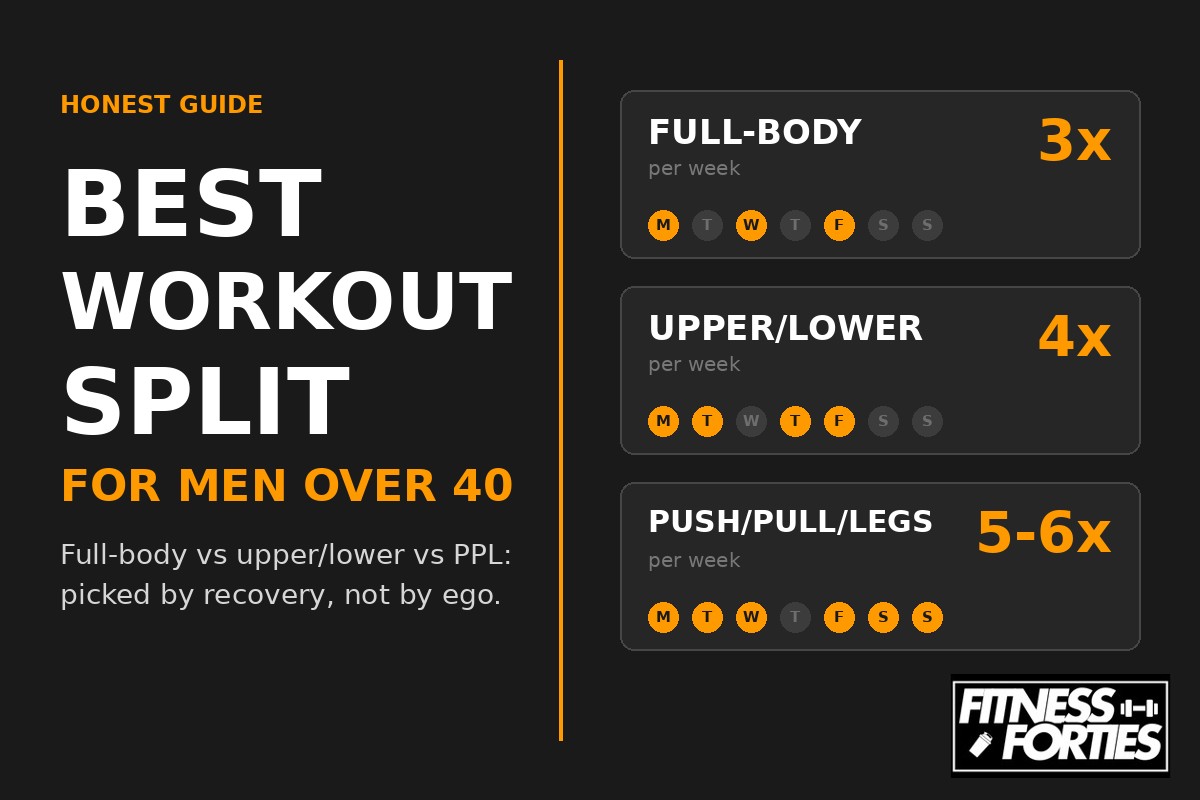
Quick Summary: The best workout split for men over 40 is whichever one you can actually recover from and repeat for months, not the one with the most Instagram appeal. Full-body training (3 sessions a week) suits limited time and needs the least weekly recovery. Upper/lower (4 sessions) is the middle ground most 40-plus lifters land on. Push/pull/legs (5-6 sessions) works only if your joints, sleep, and schedule can support that much frequency.
- What’s the best workout split for men over 40?
- Full-body training: how it works and who it fits
- Upper/lower split: how it works and who it fits
- Push/pull/legs: how it works and who it fits
- Why recovery changes the split calculus after 40
- Comparison table: full-body vs upper/lower vs PPL
- How to pick your split based on your week, not your ego
- Frequently asked questions
- Final thoughts
- References
What’s the best workout split for men over 40?
There is no single best workout split for men over 40. Full-body, upper/lower, and push/pull/legs (PPL) all build muscle at roughly the same rate when weekly volume and effort are matched. The variable that actually decides which split works for you at this age is recovery capacity, not training theory.
That single sentence is the whole argument of this article. At 25, you could pick a split based on what looked cool on a fitness forum and your body would forgive the mismatch. At 40 or beyond, a split that outruns your recovery does not just stall progress. It compounds into nagging joint pain, worse sleep, and eventually a missed session that turns into a missed month. Picking the right split is less about optimizing and more about not sabotaging yourself.
I’m 47, 182 cm (5’11”) and around 86 kg (190 lbs). I’ve trained at both ends of this spectrum: 7 days a week as a semi-professional waterpolo player until 19, and a more conservative 4 sessions a week during my current comeback. The lesson is the same either way. Frequency only helps if you can absorb it.
Full-body training: how it works and who it fits
Full-body is the simplest of the 3 candidates for the best workout split for men over 40. It trains every major muscle group in each session, spread across 3 (sometimes 4) sessions a week with a rest day between most of them. A typical week looks like squat or hinge, a push movement, a pull movement, and a core or carry exercise, done Monday, Wednesday, and Friday.
Who full-body training fits best
Full-body is the right call if you can only commit to 3 sessions a week, if you’re returning from a fitness break, if you need to rebuild your confidence, or if your joints need more days between loading a given movement pattern. Since each muscle group only gets trained 3 times a week, you get 2-3 rest days between sessions, which suits a 40-plus recovery profile better than most men expect. It’s also the most forgiving split when life gets in the way. Missing 1 of 3 sessions still leaves meaningful weekly volume; missing 1 of 6 in a Push/pull/legs (aka: PPL) split can wipe out a muscle group’s training for the week.
The trade-off is session length and per-muscle volume ceiling. Hitting chest, back, legs, and shoulders properly in one session without turning it into a 90-minute grind means you cap sets per muscle group lower than a specialized split allows. For most men over 40 training 3 days a week, that’s still enough to build and hold muscle. It’s rarely enough to maximize it.
Upper/lower split: how it works and who it fits
For many men, upper/lower ends up being the best workout split for men over 40 once time and recovery are both weighed honestly. It alternates upper-body days (chest, back, shoulders, arms) with lower-body days (quads, hamstrings, glutes, calves), typically across 4 sessions a week: upper, lower, rest, upper, lower, then 2 rest days. Each muscle group gets trained twice a week, which lines up well with the frequency research on hypertrophy.
This is the split I’d point most 40-plus lifters toward by default, and it’s close to what my own comeback log is currently built around at 4 sessions a week. You get 2 exposures per muscle group a week without cramming everything into 1 session, plus a full rest day (sometimes 2) between repeating the same joints. A meta-analysis found training a muscle twice a week produces meaningfully more hypertrophy than once a week at comparable volume (Schoenfeld et al., 2016), exactly the frequency upper/lower delivers without 5-6 gym visits.
Upper/lower and joint-friendly programming
Upper/lower also makes it easy to manage a cranky shoulder or knee without derailing the whole week. You can drop volume or swap an exercise on a single lower day without touching your upper-body progress, and vice versa. For men over 40 nursing a joint issue rather than resting it completely, that flexibility matters more than most training templates give it credit for.
Push/pull/legs: how it works and who it fits
Push/pull/legs is the split most likely to get recommended as the best workout split for men over 40 by people who haven’t accounted for your recovery. It divides training into pushing movements (chest, shoulders, triceps), pulling movements (back, biceps), and legs, usually across 5-6 sessions a week, either as a straight rotation or with a rest day every 3rd or 4th day. Each muscle group can be hit twice in a 6-day cycle.
PPL is the highest-volume, highest-frequency option of the 3, and it’s genuinely excellent for hypertrophy on paper. It’s also the split most likely to bury a 40-plus lifter who takes it on without matching recovery infrastructure: enough sleep, low enough stress, joints that tolerate near-daily loading. A systematic review of older-adult recovery found muscle function often takes over 72 hours to return to baseline after a damaging session, longer than soreness alone suggests (Hayes et al., 2023). Run a 6-day PPL rotation and some muscle groups get loaded again before that window closes.
When PPL still makes sense after 40
PPL works for men over 40 with years of consistent training behind them who sleep 7-plus hours most nights and enjoy the gym 5-6 days a week. It’s a poor first split during a comeback or a fat loss phase, when recovery capacity is already reduced by a calorie deficit. If that’s you right now, upper/lower or full-body will get you further with less risk.
Why recovery changes the split calculus after 40
Muscle mass declines by roughly 8% per decade once age-related loss sets in, and the pace accelerates further past 70 (Filippin et al., 2015). That’s not a reason to panic. It’s the reason training consistently matters more after 40 than the specific split you use, and why a split you can sustain for years beats one you can only survive for 6 weeks.
Choosing the best workout split for men over 40 comes down to recoverable volume
Recovery from resistance training genuinely slows with age. A 2024 review of exercise-induced muscle damage found that older muscle shows delayed and less efficient repair compared to younger muscle, with inflammatory and repair processes still elevated days after a session that a younger lifter would have shrugged off by then (Li et al., 2024). That doesn’t mean training less. It means matching your split’s frequency to how fast you personally recover, not to how fast a 25-year-old on YouTube recovers.
When I came back from chest rib surgery and rebuilt my training with Jeremy Boisseau, the split had to respect exactly this. What fit had nothing to do with what I could do at 19 in the pool, 7 days a week. It was about what my body could absorb that month, full stop. See our full rest day and recovery guide for men over 40 for how to build that in deliberately.
Comparison table: full-body vs upper/lower vs PPL
Here’s how the 3 candidates for the best workout split for men over 40 stack up side by side, on the factors that actually matter once you’re past 40: sessions per week, recovery demand, and who each one suits.
| Split | Sessions/week | Frequency per muscle | Recovery demand | Best for |
|---|---|---|---|---|
| Full-body | 3 | 3x/week | Low | Best for: limited time, comebacks, joint issues |
| Upper/lower | 4 | 2x/week | Moderate | Best for: most men over 40 with a normal work week |
| Push/pull/legs | 5-6 | 2x/6-day cycle | High | Best for: experienced lifters with strong recovery and free time |
How to pick your split based on your week, not your ego
Start with the honest number of days you’ll actually train, not the number you’d train in an ideal world. At 3 days, full-body wins by default; forcing PPL into 3 days a week means each muscle group gets trained once every 2 weeks, too infrequent for visible progress. At 4 days, upper/lower is close to the sweet spot the research and my own comeback log both point to. At 5-6 days with an established base and good sleep, PPL becomes worth trying.
Second, weigh your joints honestly. Managing a shoulder or knee issue points toward the split with more rest days between repeated loading, usually full-body or upper/lower over PPL. Third, don’t switch splits every 4 weeks chasing a marginal edge. Progress comes from months of consistent, progressively loaded training on 1 split, not split-hopping. See our 5 proven training principles for men over 40 and what the science shows about muscle growth after 40.
Frequently asked questions
What’s the best workout split for men over 40 with only 3 days a week?
Full-body training is the best workout split for men over 40 who can only commit to 3 sessions a week. It trains every major muscle group each session, so even a missed day still leaves meaningful weekly volume, and the 2-3 rest days between sessions suit a 40-plus recovery profile well.
Is upper/lower or full-body better after 40?
Upper/lower is generally better if you can commit to 4 sessions a week, since it trains each muscle group twice weekly, which the frequency research links to better hypertrophy than once a week at matched volume. Full-body is better if 3 sessions a week is your realistic ceiling.
Is push/pull/legs too much for a 40-year-old?
Not inherently, but it demands more from recovery than full-body or upper/lower. PPL suits men over 40 with an established training base, consistent sleep, and 5-6 days a week available. It’s a poor choice during a comeback, a fat loss phase, or any period when recovery capacity is already reduced.
How often should a man over 40 train each muscle group?
Twice a week per muscle group is a well-supported target for most men over 40, balancing enough frequency for growth against enough rest for recovery. This is exactly what an upper/lower split delivers by default, and what full-body or PPL can also hit with the right weekly layout.
Final thoughts
The best workout split for men over 40 isn’t a secret formula; it’s whichever of the 3 options above matches the days you’ll realistically train and the recovery you can realistically deliver. Most men in their 40s land best on upper/lower at 4 sessions a week. Fewer available days points to full-body. More training experience, more recovery capacity, and more available days makes PPL worth exploring.
Pick one, run it for at least 12 weeks, and judge it by whether you’re still training consistently at the end, not by how it looks on paper in week 1. I’m tracking exactly this kind of decision in my own comeback log right now, 10 weeks into a tracked cut built around 4 sessions a week.
References
- Schoenfeld, B.J., Ogborn, D., & Krieger, J.W. (2016). Effects of resistance training frequency on measures of muscle hypertrophy: A systematic review and meta-analysis. Sports Medicine, 46(11), 1689-1697.
- Schoenfeld, B.J., Grgic, J., & Krieger, J. (2019). How many times per week should a muscle be trained to maximize muscle hypertrophy? A systematic review and meta-analysis of studies examining the effects of resistance training frequency. Journal of Sports Sciences, 37(11), 1286-1295.
- Hayes, E.J., Stevenson, E., Sayer, A.A., Granic, A., & Hurst, C. (2023). Recovery from resistance exercise in older adults: A systematic scoping review. Sports Medicine – Open, 9(1), 51.
- Li, D.C.W., Rudloff, S., Langer, H.T., Norman, K., & Herpich, C. (2024). Age-associated differences in recovery from exercise-induced muscle damage. Cells, 13(3), 255.
- Filippin, L.I., Teixeira, V.N.O., da Silva, M.P.M., Miraglia, F., & da Silva, F.S. (2015). Sarcopenia: a predictor of mortality and the need for early diagnosis and intervention. Aging Clinical and Experimental Research, 27(3), 249-254.
Get the FitnessForties weekly
One email per week. Real protocols, no hype, written by a 47-year-old who is still in the gym. Plus: my free body transformation blueprint PDF.


Leave a Reply